Directions: Choose the integration technique that can be used to solve each of the following integrals. You do not need to solve the integrals; just identify the method.
Suppose the work required to stretch a spring 4 meters beyond its natural length is 24 J. How much force would be required to hold the spring stretched 10 meters beyond its natural length?
A 20 ft rope weighing 3 lb/ft hangs vertically from the edge of a roof. A 10 lb bucket is attached to the lower end of the rope. Find the work required to pull the rope and bucket to the roof.
Use disks to setup the integral that gives the volume of the solid generated by rotating the region \(R\) about the \(x\)-axis. Do not evaluate the integral.
Use washers to setup the integral that gives the volume of the solid generated by rotating the region \(R\) about the line \(x = 3\text{.}\)Do not evaluate the integral.
Use shells to setup the integral that gives the volume of the solid generated by rotating the region \(R\) about the line \(y = -2\text{.}\)Do not evaluate the integral.
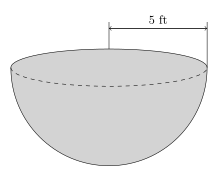
The tank in a shape of a hemisphere with radius 5 ft is full of water. Set up, but do not evaluate, the integral that gives the work done in pumping all the water to the top of the tank. Use the fact that water weighs 62.5 lb/ft\(^3\text{.}\)
The base of a solid is the region bounded by the curve \(y = 5 - x^2\) and the \(x\)-axis. The cross sections of the solid are rectangles perpendicular to the \(y\)-axis with height equal to twice the base. Find the volume of this solid.
Suppose \(f\) is a function such that \(f'\) and \(f''\) exist, and \(f(0) = 1\text{,}\)\(f'(0) = 5\text{,}\)\(f(2) = 3\text{,}\)\(f'(2) = 7\text{.}\) Which of the following correctly evaluates \(\displaystyle\int_{0}^{2} 3x f''(x)\,dx\text{?}\)
The base of a solid is the triangle enclosed by \(x + y = 5\text{,}\) the \(x\)-axis, and the \(y\)-axis. Its cross sections are semicircles perpendicular to the \(y\)-axis. Which integral below calculates the volume of the solid?
Which of the following integrals gives the volume of the solid obtained by revolving the region bounded by \(y = 4x - x^2\) and \(y = 0\) about the line \(x = -2\text{?}\)